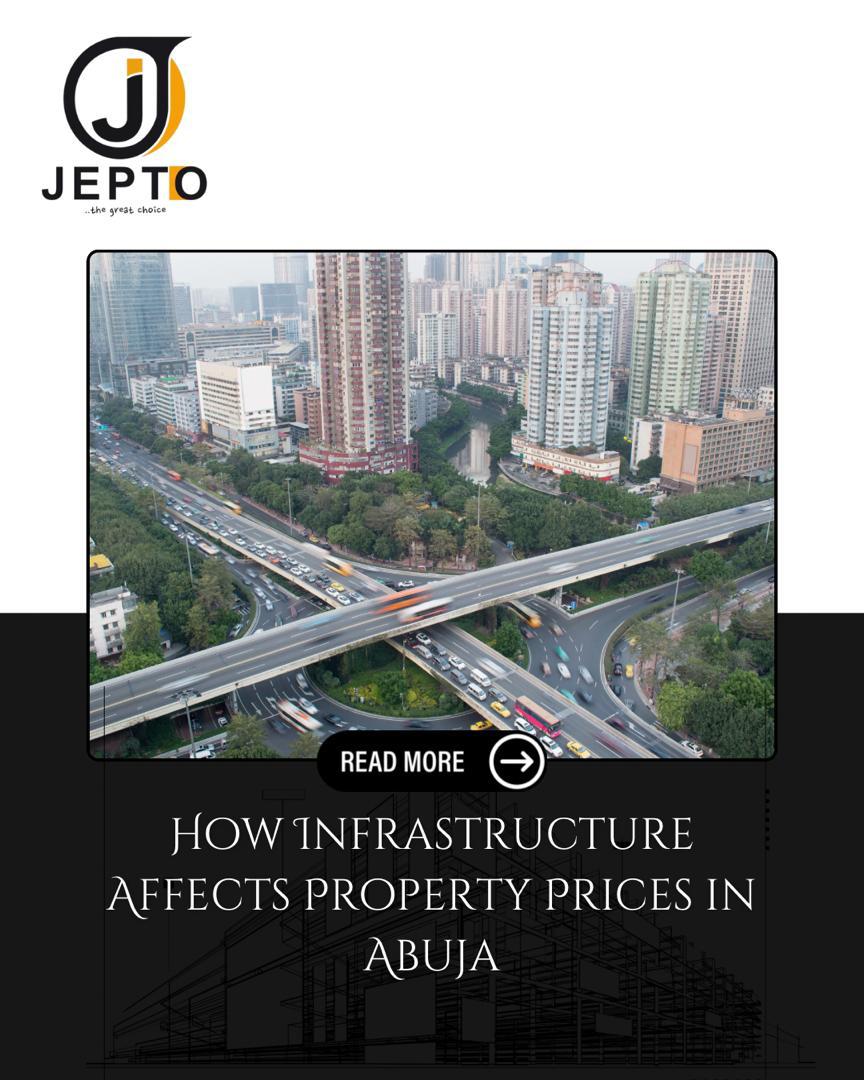
Infrastructure development is one of the most powerful drivers of property prices in Abuja. As Nigeria’s capital expands, new roads, bridges, utilities, and public services transform neighborhoods—unlocking value and attracting both residents and investors. In this article, we’ll explore how various infrastructure projects influence property prices in Abuja, and why partnering with Jepto ensures you make informed, profitable real estate decisions in the FCT.
1. Road Networks & Accessibility
Impact on Property Prices in Abuja
- Improved Connectivity: New highways (e.g., Airport Road expansions) reduce commute times, making suburbs like Lugbe and Kubwa more attractive. Lower travel times often lead to a 15–25% uplift in nearby property prices in Abuja.
- Increased Demand: As accessibility improves, demand for land and homes along major corridors spikes. Areas once considered remote suddenly become prime real estate.
What to Watch For
- Upcoming Federal Capital Territory (FCT) road projects
- Planned ring roads and feeder routes
- Proposed bus-rapid transit (BRT) lanes
2. Utilities & Public Services
Influence on Property Prices in Abuja
- Stable Power Supply: Neighborhoods with reliable electricity (e.g., through government power plants or solar mini-grids) command higher rents and sales prices. Reliable power can boost property prices in Abuja by up to 20%.
- Water & Sewage Systems: Access to treated water and modern drainage reduces health risks and maintenance costs, pushing property prices in Abuja upward.
Key Considerations
- Check proximity to treatment plants and main water lines
- Confirm access to municipal waste collection and drainage
- Look for areas benefiting from new borehole projects or water authority upgrades
3. Social Amenities: Schools, Hospitals & Markets
Effect on Property Prices in Abuja
- Education Hubs: Good schools (public or private) in districts like Gwarinpa and LifeCamp drive families toward these zones, inflating property prices in Abuja for houses and apartments.
- Healthcare Access: Clinics and hospitals improve quality of life. Properties near medical centers (e.g., in Garki or Maitama) often see a 10–15% premium.
- Commercial Markets: Well-planned markets and shopping malls create urban centers that raise local property prices in Abuja by concentrating services and foot traffic.
Practical Tips
- Map out the “amenity radius”—properties within 1–2 km of top schools or hospitals often enjoy the highest premiums.
- Investigate planned social infrastructure in Abuja’s master plan to predict future hotspots.
4. Transportation Hubs & Rail Links
Role in Property Prices in Abuja
- Rail Corridors: The Abuja Light Rail project has already begun to reshape values along its route. Properties near rail stations see early investors earning significant gains in property prices in Abuja.
- Airport Proximity: Areas around Nnamdi Azikiwe International Airport, such as Lugbe, enjoy higher land values as logistics and hospitality sectors grow.
What to Monitor
- Completion dates for rail phases
- New terminal or cargo handling expansions at the airport
- Planned multimodal transport interchange stations
5. Security Infrastructure
Impact on Property Prices in Abuja
- Gated Communities & CCTV Networks: Developments that include perimeter fencing, security checkpoints, and surveillance systems often list homes at a sizable premium, reflecting lower risk and higher buyer confidence. This directly influences property prices in Abuja, especially in emerging estates.
- Police Posts & Fire Stations: Proximity to emergency services enhances safety and can lift property values by 5–10%.
Evaluation Tips
- Assess developer-provided security features before purchase
- Research FCTA plans for new police or fire stations in target areas
6. Telecommunications & Digital Connectivity
Influence on Property Prices in Abuja
- High-Speed Internet & 5G: Neighborhoods with fiber optic and 5G coverage are more attractive to professionals and businesses, boosting property prices in Abuja for both residential and mixed-use developments.
- Smart City Initiatives: Pilot projects for IoT-enabled street lighting or traffic sensors can signal future growth corridors.
Action Points
- Verify broadband and mobile network coverage maps
- Look for planned telecom infrastructure upgrades on FCTA websites
7. Long-Term Value & Compounding Growth
Infrastructure improvements rarely happen overnight. As each project completes, property prices in Abuja tend to follow in a phased manner:
- Announcement Phase: Prices inch up as savvy investors anticipate growth.
- Construction Phase: Speculative buying drives a steeper climb in nearby land values.
- Completion Phase: Wider market recognition cements the premium, benefiting early adopters most.
Investors who track infrastructure timelines and buy before or during the construction phase often achieve the best returns on property prices in Abuja.
Partner with Jepto for Infrastructure-Savvy Investing
Navigating the complex interplay between infrastructure and property prices in Abuja requires local expertise. Jepto offers:
- Up-to-date briefings on FCTA infrastructure plans
- Data-driven forecasts of how projects will reshape property values
- Curated property listings aligned with emerging infrastructure corridors
- End-to-end support—from site visits to title verification
Contact Jepto today to leverage infrastructure insights and secure your ideal property in Abuja. Let Jepto guide you to the neighborhoods set for the next wave of property prices in Abuja’s growth!


Leave a Reply